Why Manifestation Doesn’t Work for Most People
Updated: Feb 18

Manifestation is often presented as a simple formula: think positively, visualize clearly, believe strongly, and reality will respond. For some people, this approach appears to work. For many others, it feels inconsistent or exhausting. Not because they are incapable. Not because they are unworthy. And not because they “don’t believe hard enough.”
It often fails because the body is dysregulated.
This concept is explored in greater depth in Quantum Architect: How Identity Shapes Reality Through Coherence, where regulation is positioned as the foundation of lasting change.
The Missing Foundation
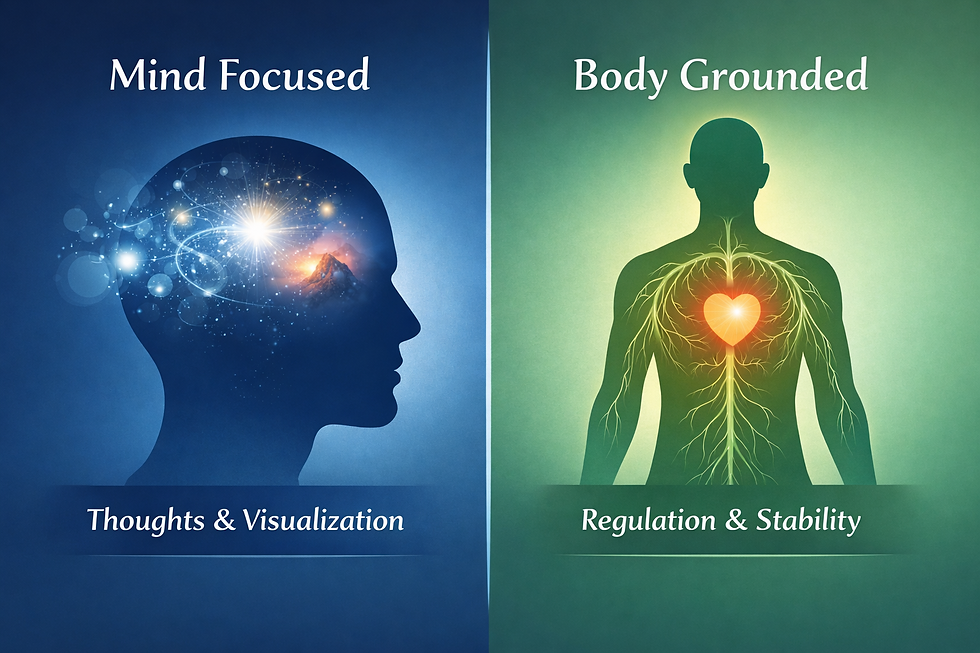
Most manifestation advice focuses on thoughts and intention. Very little of it addresses nervous system regulation. If the body is in a chronic state of stress, urgency, or survival, visualization becomes strain. Affirmations feel forced. Positive thinking creates tension instead of relief.
You cannot stabilize a new outcome from a destabilized system. The nervous system will always prioritize safety over intention. If the body does not feel steady, it will default to familiar emotional patterns and behaviors — even when the mind is trying to imagine something better. Until the body feels regulated, intention and imagination remain ideas rather than lived states.
Why Positive Thinking Backfires
When internal state and external affirmation don’t match, friction increases. You say, “Everything is working out for me.” But your body feels anxious. You visualize abundance. But your system feels scarcity. That mismatch creates internal conflict.
The nervous system prioritizes regulation over imagination. And in an unregulated system, regulation often means returning to what feels familiar — not what feels expansive. This is why people often feel worse after trying to manifest. They are layering intention on top of a nervous system that is still in stress or survival mode.
Identity Is More Powerful Than Intention
Most manifestation methods focus on what you want. But reality tends to respond more consistently to who you are when you are not trying. Your baseline emotional state, your ability to regulate under pressure, and your identity in moments of uncertainty shape perception and behavior in subtle but powerful ways.
As internal stability strengthens, opportunities are interpreted differently. Decisions shift. Boundaries adjust. Even energy changes — not because reality was forced, but because steadiness reorganized action from within.
This relationship between regulation, identity, and lived experience is explored in greater depth in Quantum Architect: How Identity Shapes Reality Through Coherence, where stabilization is positioned as the foundation of lasting change..
The Role of Emotional Coherence
Emotion is not the obstacle. Emotion is information. When the nervous system is regulated, emotion becomes signal rather than reaction. You can feel fear without collapsing into it. You can feel desire without urgency. You can imagine without strain. Coherence means the body, emotion, and intention are not in conflict. This is when change becomes sustainable.
Why Effort Often Fails
Effort-based manifestation tries to override biology. But biology wins.
If the nervous system is wired for hypervigilance, the mind will scan for threat. If identity is organized around instability, perception will filter for confirmation. Trying harder only strengthens the loop.
Stabilizing first interrupts it.
What Actually Works
Lasting change begins with regulation.
When the nervous system is steady:
• Emotion softens
• Imagination becomes accessible
• Identity feels less defensive
• Action becomes clearer
From this state, intention does not need to fight for space. It integrates. Manifestation is not about convincing reality. It is about stabilizing the internal conditions that allow different outcomes to become accessible.
The Quantum Architect Workbook: Embodying the Method of Conscious Creation provides guided practices designed specifically to help regulate the system before engaging imagination-based work.
A Different Approach
If manifestation has felt inconsistent or exhausting, the solution is not stronger belief. It is deeper regulation.
Before visualization, regulate.
Before affirmation, stabilize.
Before intention, soften the body.
Change does not require force. It requires coherence. And coherence begins in the nervous system.
Continue the Work
If this perspective resonates, the full framework is outlined in:
Quantum Architect: How Identity Shapes Reality Through Coherence
Quantum Architect Workbook: Embodying the Method of Conscious Creation
Because you cannot shift reality from a dysregulated body.
Leadership Stability Starts With Awareness
If you’re exploring regulation and performance, begin with the 3-minute Regulation Assessment.



Comments